
Cart is empty

Rebar (TMT Bars)Products found: 5
Questions about this Product?
Please sign in so that we can notify you about a reply
TMT Bars are high-strength reinforcement bars designed to provide superior structural support in concrete construction. Manufactured using advanced technology, they offer excellent tensile strength, flexibility, and earthquake resistance. Suitable for residential, commercial, and infrastructure projects, they ensure long-lasting structural integrity. Their corrosion-resistant properties enhance durability and reduce maintenance costs. TMT Bars are an essential component for building safe and reliable structures.
The U.S. equivalent of TMT (Thermo-Mechanically Treated) Bars is steel reinforcing bars, commonly called rebar. In the U.S., rebar is specified by ASTM standards (primarily ASTM A615, with others such as ASTM A706 for weldable/seismic applications) rather than by the manufacturing process.
A comparison looks like this:
| U.S. Equivalent | ||
|---|---|---|
| ASTM A615 Deformed Steel Reinforcing Bars | Seismic Grade TMT Bars | Earthquake-resistant structures |
| Epoxy-Coated, Galvanized, or Stainless Steel Rebar | Both TMT bars and U.S. reinforcing bars provide:
Common U.S. rebar gradesThe most common grades are:
Grade 60 ASTM A615 rebar is the closest equivalent to the TMT bars used in most residential and commercial construction. U.S.-focused product descriptionSteel Reinforcing Bars (Rebar) are high-strength deformed steel bars designed to provide superior reinforcement and structural support in concrete construction. Manufactured to meet ASTM standards, they offer excellent tensile strength, ductility, and long-term durability. Suitable for residential, commercial, and infrastructure projects, they enhance the strength and stability of concrete structures. Available in a range of grades and sizes, reinforcing bars are engineered to withstand heavy loads and demanding environmental conditions. Corrosion-resistant options, including epoxy-coated and galvanized rebar, are available for increased durability in harsh environments, making rebar an essential component for safe, reliable, and long-lasting construction. This wording reflects the terminology and standards that U.S. engineers, contractors, and building suppliers commonly use. |
 |
|||
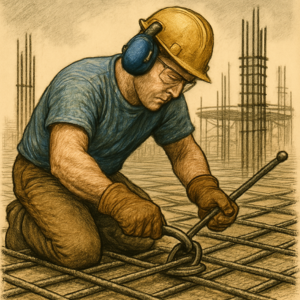
Rebar is installed in Concrete Forms to add tensile strength and durability to Concrete.
Process - Confirm layout and bar sizes with structural drawings.
Cut & Bend Rebar: Use appropriate tools to cut and shape Rebar as specified.
Place Rebar: Position bars in the formwork according to spacing and coverage requirements.
Tie Rebar: Use Tie Wire to secure Rebar Intersections.
Support: Use Rebar Chairs or Blocks to maintain required spacing from form surfaces.
Install Rebar Caps: Place caps on all vertical/protruding bars Immediately.
Tools and Materials - Rebar Cutter and Bender, Tie Wire and Rebar Chairs are some fundamentals.
⚠️ Rebar Cap Safety Reminder ALWAYS Cap Exposed rebar! Prevents impalement injuries Required by OSHA for vertical and protruding rebar Use approved caps (mushroom or metal-reinforced for high-risk areas).